
Proofreading & Editing: A Simple Guide for Better Academic Writing
Improve your academic writing with practical proofreading and editing tips. Learn how to check grammar, clarity, structure, citations, and formatting.
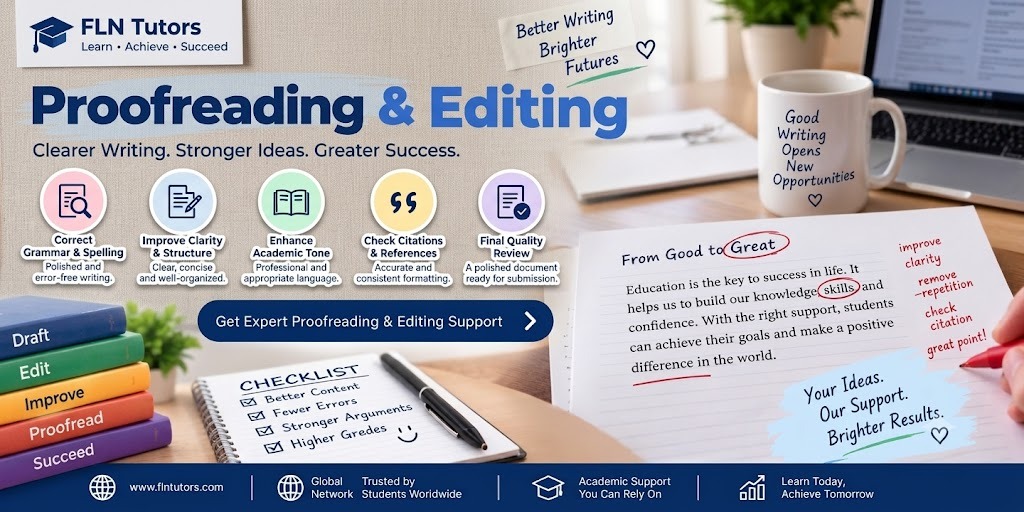
Writing an assignment, essay, dissertation, or research paper takes time and effort. However, finishing the first draft is only part of the process. Before submitting your work, it is important to review it carefully for grammar mistakes, unclear sentences, spelling errors, and formatting issues. This is where proofreading and editing
become important. Both processes can help make your academic writing clearer, more accurate, and easier to read. In this guide, we’ll explain the difference between proofreading and editing and share simple tips for improving your work.
What Is Proofreading?
Proofreading is the final check of your written work before submission. It focuses mainly on small errors that may have been missed during writing or editing. During proofreading, you should look for spelling mistakes, grammar errors, punctuation problems, typing mistakes, inconsistent capitalization, and formatting issues.
The aim is to make sure your final document looks polished and professional.
What Is Editing?
Editing is a deeper review of your writing. Instead of focusing only on small mistakes, editing looks at the overall quality and clarity of your content. When editing, you may improve sentence structure, remove unnecessary repetition, reorganize paragraphs, clarify confusing ideas, and improve the flow between sections. Good editing should make your writing easier to understand without changing the intended meaning.
What Is the Difference Between Proofreading and Editing?
Proofreading and editing are related, but they serve different purposes. Editing usually comes first. It focuses on improving your ideas, structure, clarity, and overall writing. Proofreading normally comes after editing. It is the final check for grammar, spelling, punctuation, formatting, and other minor errors. For example, rewriting a confusing paragraph is editing, while correcting a spelling mistake in that paragraph is proofreading.
Why Are Proofreading and Editing Important?
Even a well-researched assignment can be difficult to follow if it contains unclear sentences or frequent errors.
Proofreading and editing can help improve readability, maintain a consistent academic tone, and ensure that your ideas are presented clearly. They also give you an opportunity to check whether each section supports your main topic or research question.
Start With the Overall Structure
Before checking individual words and sentences, look at the overall structure of your document.
Make sure your introduction clearly introduces the topic, your main sections appear in a logical order, and your conclusion brings together the key points.
Ask yourself whether each paragraph has a clear purpose. If a paragraph does not contribute to your main argument or topic, consider revising or removing it.
Check Your Sentences for Clarity
Read each sentence carefully and ask whether its meaning is easy to understand.
Long or complicated sentences can sometimes make academic writing harder to follow. If a sentence contains too many ideas, consider dividing it into two shorter sentences. Also remove unnecessary words and repeated information. Clear writing is usually more effective than writing that uses complicated language without a clear purpose.
Check Grammar, Spelling, and Punctuation
Once you are happy with the content and structure, focus on smaller errors.
Check subject-verb agreement, verb tense, spelling, commas, apostrophes, capitalization, and sentence endings.
Automatic grammar tools can be helpful, but do not accept every suggestion without checking it. A tool may not always understand the meaning or academic context of your sentence.
Review Your References and Citations
References are an important part of academic writing. Make sure all sources are cited according to the style required by your university. Check that author names, publication years, titles, and other details are accurate and consistent. You should also make sure that sources cited in your text appear in your reference list where required.
Check Formatting and Presentation
Formatting can affect how professional your document looks.
Review headings, font sizes, line spacing, page numbers, margins, tables, figures, and reference formatting. Follow the specific instructions provided by your university or lecturer.
Consistency is important. Similar headings and sections should follow the same formatting style throughout your document.
Read Your Work Aloud
Reading your work aloud is a simple proofreading technique that can help you notice awkward sentences, repeated words, and missing information.
When reading silently, your brain may automatically correct small mistakes. Reading aloud can make some of these problems easier to notice.
You can also read slowly, one paragraph at a time, instead of trying to review the entire document quickly.
Take a Break Before Proofreading
If possible, leave some time between writing and proofreading.
After working on the same document for several hours, it can become difficult to notice mistakes. Returning to your work later can help you review it with a fresh perspective.
Even a short break can make proofreading more effective.
Common Proofreading and Editing Mistakes
One common mistake is trying to edit and proofread everything at the same time. It is usually easier to check your structure and ideas first, then focus on grammar and spelling.
Students may also rely too heavily on automated tools, skip citation checks, or proofread too quickly.
Another common issue is changing sentences without checking whether the original meaning has been preserved. Always read edited sections again to make sure they still communicate your intended message.
Need Support With Proofreading & Editing?
Reviewing a long academic document can take considerable time, especially when you have been working on it for several weeks.
If you are looking for additional academic support, our Proofreading & Editing service can help with different stages of reviewing and improving your academic work.
Money-Back Guarantee
Not satisfied with the final work? Get a full refund. No questions asked.
Learn more →100% Confidential
Your identity, order details and institution are never shared with any third party.
Learn more →On-Time, Every Time
Miss your deadline and we'll credit your next order. We take deadlines seriously.
Learn more →Get started today
Ready to get expert help?
Join 8,400+ students who've trusted FLN with their academic work. Delivered on time, every time.